
Starting a Dracut Residents Directory Search
Dracut resident records are split by purpose, and that split shapes every lookup. The Town Clerk holds annual street-list work, vital records, town materials, licenses, and the municipal records-request route. The assessor and parcel map answer a different question. They tie a parcel, address, and assessed owner together. Middlesex North land records document title parties and legal descriptions. The library and Historical Society preserve the older household trail.
Start with the record closest to the fact you already know. Do not force every question into a name search. Keep each result in its proper role. An assessor owner is not automatically a current occupant. A deed party may not live at the property. A directory line is historical evidence, not current proof. The strongest Dracut residents directory result comes from two independent sources that agree on an address, date, relationship, or parcel.
- For a current address, locate the parcel through the town map or assessment route and note its address and MBL or parcel identifier.
- Check the recorded-land index for the title party, document date, and book, page, or document reference.
- Use the individual Massachusetts voter lookup only for its intended personal registration purpose, or ask the Town Clerk about a lawful local street-list request.
- For a past household, consult the 1946 reverse address index or other Lowell Suburban and Dracut directory runs, then compare the result with a census, deed, or vital record.
- When a municipal item has no public portal, make a focused written request to the custodian instead of assuming the record does not exist.
Note: A no-result can reflect spelling, coverage, a recent move, or a protected record rather than a definitive negative finding.
Dracut Resident Records Custodians
Dracut sits in Middlesex County. Yet its land and court trail runs through Lowell in practice. The Town Clerk is the municipal starting point. County-side services come from the Middlesex North Registry of Deeds and the Lowell court locations. Massachusetts agencies add statewide vital, voter, archive, and license routes. Each office has a narrow job. So the office name matters as much as the search term.
Dracut Assessors
Town assessment and property records
Dracut, MA 01826
978-453-2451
The Clerk lists hours of Monday, Wednesday, and Thursday from 8:00 to 4:30, Tuesday from 8:00 to 6:00, and Friday from 8:00 to noon. Ask there about locally held certificates and street-list formats. The same office handles municipal records and the Town's request procedure.
Dracut Address Records Begin With a Parcel
The Town offers two property tools, related but not identical. The public Dracut GIS viewer invites searches by Owner, Address, or ID. For name or address searching, the Town also directs users elsewhere. That destination is the Vision assessment database. Start with the address when the goal is to identify a parcel. Keep the map ID or MBL with your notes. The assessor material describes location, size, value, ownership, improvements, and demolitions. The map supplies spatial context.
Both tools need careful reading. A situs address marks the parcel's physical location. A mailing address may show where notices go. Neither label proves that every person tied to the address lives there. The GIS carries a parcel update dated February 18, 2026 and an assessing update dated June 23, 2026. The Town itself disclaims accuracy, completeness, and timeliness. Take a title question to a deed.
| GIS field | Type | Required | How it helps |
|---|---|---|---|
| Owner | Text | Optional | Tests an assessment-name route. |
| Address | Text | Optional | Locates a mapped parcel by street address. |
| ID | Text | Optional | Returns to the parcel when street text varies. |
| Street, ZIP, exemption filters | Unknown | Unknown | No official text capture verified these controls. |
For a full address-by-address method, follow the detailed Dracut street directory route once the parcel is known.
Dracut Street Lists Are a Different Roll
Massachusetts has no ordinary public statewide voter roster to browse. The Secretary of the Commonwealth's individual registration search takes a first name, last name, date of birth, and a five-digit residential ZIP. It includes an acknowledgement that it serves the individual voter. It returns registration or pre-registration status, active or inactive standing, polling location, and elected officials. That is useful for personal verification. It will not build a Dracut household list.
The local route is the annual street list. It is held through the Town Clerk under Massachusetts election law. Dracut's annual census form documents dwelling address, resident name, mail-to information, phone, date of birth, and voter status. It also covers moved or deceased markers and other statutory fields. Confidential classes, unlisted entries, minors, nonrespondents, and people who never register all appear. Each one limits what a list represents. Ask for a specific year. Ask for a specific arrangement, such as by street, precinct, or resident. Ask the Clerk about the production charge too.
Current Dracut Resident Directory Sources
A current Dracut residents directory is a set of record types, not one master file. Each type establishes something different. The table separates those jobs. It also shows why every result needs a source label. An assessment card may support a parcel-owner connection. A voter-related record has its own access rules. A deed records a legal transaction rather than daily residence.
| Record source | What it can show | Keeper | Access route |
|---|---|---|---|
| Assessment database and GIS | Parcel, situs, assessed owner, value, map context | Dracut Assessors | Public Vision and GIS tools; office help |
| Annual street list | Statutory resident and voter-list fields | Town Clerk | Local request under M.G.L. c. 51 rules |
| Recorded land | Grantors, grantees, document and legal-description trail | Middlesex North Registry | MassLandRecords, copy request, Registry help |
| Town staff and civic material | Published public-role or meeting context | Town departments and Agenda Center | Town pages, minutes, and request route |
| State professional or business records | Public license or business relationship | Massachusetts agencies | Official license and corporate portals |
A licensed professional or public business filing can answer a role question. But it should not be turned into a private address profile. The Massachusetts eLIPSE license search offers individual and business tabs. Optional fields cover name, city, state, ZIP, board, license type, and license number. A MyMassGov account is not required for a search.
Note: Keep the date searched with every record. Keep the result role with it too, especially for common names and older filings.
Middlesex North Deeds Clarify Dracut Title
Middlesex North deeds open Dracut's title history to anyone with patience. The recorded-land name index is computerized back to 1976. The name search casts a wide net. You can filter by business or last name, first and middle name, party type, document type, town, and recorded-date range, with Like or Compressed matching. Leave the middle initial blank on a first pass, then narrow with town, dates, document type, and the image itself. One caution matters. Imports from 1976 through 1986 can carry a document type of none, so a tight filter may hide the deed you want.
Older Dracut work takes a different route. Book 1132 opens in January 1950. Books 1 through 1131 run from 1855 through December 1949 as unindexed property images. Earlier still, you need town, book, and page. The Registry's pre-1976 grantor and grantee pages bridge that gap nicely for Dracut deed research. Viewing, printing, and downloads are free. Certified remote copies take a record reference: $5 for most documents or plans, $15 for mortgages, and a call for anything over ten pages.
- Parcel or MBL
- An assessor or GIS identifier that helps keep a property stable when address spelling differs.
- Index
- A finding tool that points to a record. It is not the same as the deed image or a certified copy.
- Grantor and grantee
- The party transferring an interest and the party receiving it in a recorded instrument.
- Criss-cross directory
- A reverse address guide that starts with a street and number rather than a person's name.
Dracut's 1946 Address Index Is Unusual
A 1946 Polk's Lowell City Directory held by the Historical Society carries something rare: a reverse Street and Address Index. It runs a street number straight to a surname. It does not prove title. Nor does it catch everyone sharing the surname. The better move is to carry the surname into the alphabetical section and read the published notation there. Then compare it against a deed, census schedule, vital record, or cemetery evidence.
Dracut's directory story is regional. The town appears in stand-alone volumes and in Lowell Suburban titles shared with nearby communities. A missing Dracut year may simply mean a skipped publication, not a family's move. The collection starts with an 1896-97 Lowell Suburban run. Later publishers include Henry M. Meek, Sampson, Murdock & Co., Naumkeag Directory Co., and R.L. Polk & Co. Polk material runs to 1967. Proof of a final printed year is lacking.
Note: The 1898 directory drops the word street after a road name and uses short abbreviations, so preserve the text exactly before modernizing an address.
Dracut Vital Records Have Time Limits
Vital records in Dracut start at the Town Clerk. The Dracut Vital Records page routes local requests there. Birth records stay local when the parents lived in Dracut at the birth, death records when the person lived in town at death, and marriage records follow intentions filed in Dracut. Statewide certificates from 1936 forward generally belong to the Registry of Vital Records and Statistics, or RVRS. Earlier local material still runs through municipal registrars.
Restrictions matter here. Birth and marriage records close for 90 years, and death records for 50, under M.G.L. c. 46, § 2A. Full Social Security number access on a death record now demands legitimate need under M.G.L. c. 46, § 1, as amended by St. 2025, c. 68, effective July 1, 2026. RVRS takes requests in person, by mail, by phone, and online. Eligibility is its own question. None of that guarantees a copy. A public index hit or an old open record does not settle eligibility for a certified copy.
Verifying Dracut Court Record Leads
Dracut court records lead to Lowell. Lowell District Court serves the town, and Middlesex Probate and Family Court North handles probate and family matters from its Lowell seat. The Massachusetts Trial Court public search offers Name, Case Type, Case Number, and Ticket or Citation modes. Civil name search uses last, first, and company fields. Case Type searching caps dates at a 30-day range. A hit shows plenty. Party, event, docket entry, case number, case type, dates, and any disposition can all appear.
Treat a docket as a lead. It does not prove a Dracut residence. Nor can it show that two same-named parties are the same person. Confirm court, role, date, and case type, then ask the clerk about an official file or copy. Sealed, juvenile, adoption, protected family, medical, and similar restricted matters stay out of public view. Courthouse terminals and the Lowell clerk still matter when a browser falls short.
Dracut Cemetery Records Add a Local Trail
Dracut maintains seven municipal cemeteries: Bailey, Richardson, Varnum, New Boston, Hildreth Street, Oakland, and Hamblett. The Cemetery Division handles lot sales, deed transfers, foundations, and burials. Its current public research route is the Chronicle Dracut cemetery search, where the public entry screen supplies search text, an Advanced control, and cemetery filters. Cemetery evidence can suggest a burial place, cemetery, or family connection. It cannot establish a current home address.
Two town-maintained cemeteries have Lowell postal addresses. That is a useful reminder that a postal city, municipal custodian, historic boundary, and current parcel can all be different. The Town reports a recent digitization project for cemetery documents and mapping, making the public search an especially useful complement to older directory and vital-record research.
Massachusetts sex-offender information also has a separate official public-information route with its own statutory limits. Use only the official process and never republish sensitive information or use it to threaten, harass, or harm anyone.
Official Massachusetts sex-offender information shows the limited public route and its safeguards.
The image highlights the official Massachusetts route and its safeguards.
Dracut Public Records Request Options
The Town keeps a Public Records Request form for records that never made it online. Massachusetts law shapes the whole process. M.G.L. c. 66, §§ 1-10 works alongside 950 CMR 32.00 to set the rules. Describe an existing record with reasonable specificity. Then deliver the form by hand, first-class mail, or email. The Records Access Officer normally answers within 10 business days. Still, exemptions, extensions, clarification requests, and lawful fees can stretch that timeline.
The form itself is simple. It asks who is submitting. It also asks what record is wanted, which department holds it, and for an acknowledgement. The Town Clerk and Assistant Clerk serve as Records Access Officers. They handle everything except school records. Anything past two hours of staff time may carry lawful costs. Narrow the ask to a date range, an address, a department, and a document type. The Town cannot invent new lists or hand over protected material.
| Official record route | Best use | Strength | Limit |
|---|---|---|---|
| Town portal or Clerk request | Existing municipal record | Direct custodian route | Exempt or uncreated material may not be released |
| Registry image or certified copy | Land document and title trail | Recorded legal instrument | Title party is not an occupant list |
| Library or Historical Society | Directory, map, report, or newspaper context | Historical household lead | Collection gaps and historical dates matter |
Dracut Historical Directory Collections
Start with the Dracut Library's genealogy and local-history services. Old directories, town reports, historic books, Ancestry Library Edition, FamilySearch affiliate access, NewspaperArchive, and the local vital-record volume are gathered in one place. The Library sits at 28 Arlington Street. Staff there do not conduct legal, tax, medical, microform, or obituary research. Ask for a collection referral and then use the item and its date yourself.
The Historical Society inventory adds a directory shelf, local maps, tax rolls from 1842-49 and 1861-93, genealogy files, and town reports reaching roughly from 1832 forward. A good pattern for a past household: pair one directory year with the nearest public census year. Confirm title with a deed. Anchor life events with vital or cemetery records. The collection-by-collection route continues on the Dracut city directory page. The Massachusetts eLIPSE portal offers a separate official surface for verifying a public professional or business relationship.
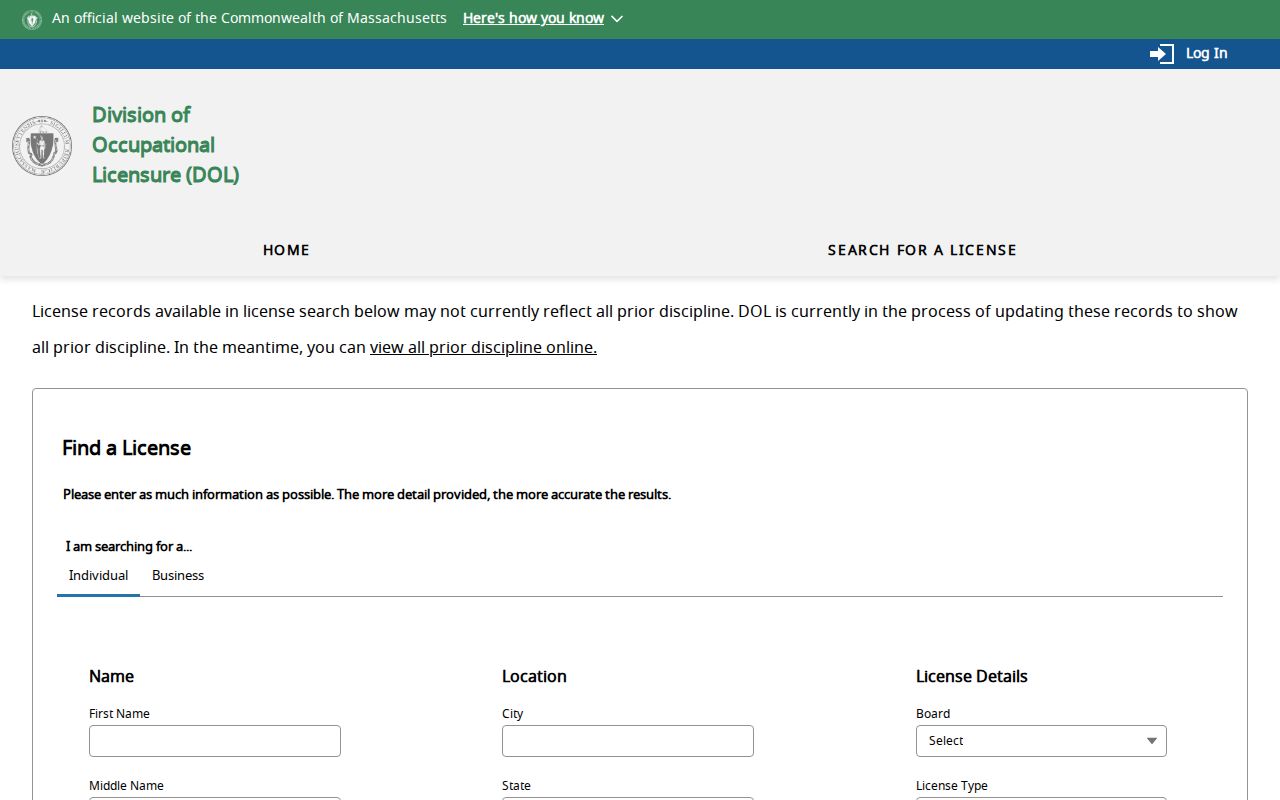
A license status can back up a role check. Weigh it against the record's date. Never treat it as proof of where someone lives.
Dracut Resident Record Privacy Boundaries
Missing information usually has a reason. Massachusetts exemptions shield personal identifying data and juvenile records. They also cover medical material, investigative files, and protected victim information. The Address Confidentiality Program gives eligible survivors and certain protected health-care users a substitute address. Confidential voter classes follow their own rules. So do restricted RMV data, sealed court files, and sensitive vital records.
Spot an error or a gap? Take it to the original custodian. Ask about correction, redaction, an exemption, or the right request channel. A commercial compilation and a government record follow separate procedures. Never copy Social Security numbers or financial account data. That also goes for identification numbers and a protected address in a document image. Just because data is public does not make it fair game for broad republication.